
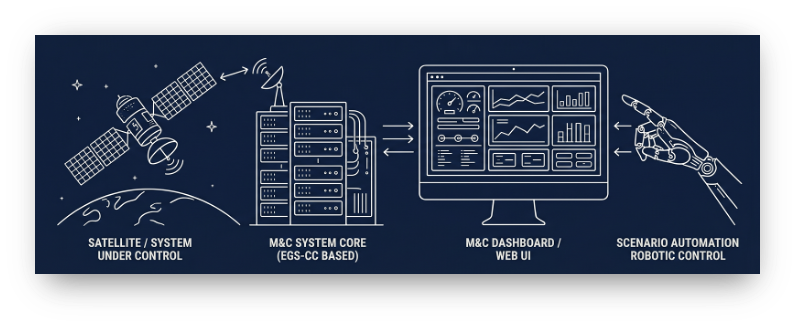
 A shared core on which Europe builds its own mission control systems. And we help build it.
What is EGS-CC?
Every satellite needs software on the ground to test it, monitor it and command it. For years, each organisation built or bought these tools on its own, starting from scratch for every mission.
EGS-CC (European Ground System – Common Core) answers that problem: one common foundation that can be shaped to fit your needs, from a tiny CubeSat to complex exploration missions and constellations of hundreds of satellites.
Its biggest strength is continuity. The same software, the same definitions and the same procedures work at every stage of a satellite’s life: on the bench in the integration hall, during pre-launch testing, and in daily operations in orbit. Nothing has to be rewritten or moved from one tool to another.
How did it come about?
The idea came from industry itself. At the start of the previous decade, Europe’s largest satellite manufacturers approached the European Space Agency (ESA) with a simple request: let’s stop each building the same thing again. In 2012, agencies and companies signed an agreement at the highest level, committing to develop one shared system and use it in their future projects.
The founders include ESA, Germany’s DLR, France’s CNES, the UK Space Agency, and Airbus, Thales Alenia Space and OHB. Creating the system was a major joint effort: around twenty companies from ten countries worked on it. Today EGS-CC is a mature product. New releases come out regularly, and a dedicated team called the Release Agent looks after its evolution.
Openness, independence, sovereignty
EGS-CC is not something you buy in a box, and that is exactly its strength. It is software your organisation can fully control, from the first line of code to deployment.
In space, trust in software cannot rest on promises. That is why EGS-CC is provided with its complete source code, under the ESA Community Licence (weak copyleft, Type 2.4). Every user gets everything, not just a finished program.
What does that mean in practice?
– Full control over your software supply chain. You can see every element: what is inside, where it comes from and how it works. No black boxes and no hidden dependency on a single vendor.
– Independence from any single supplier. If a vendor disappears, changes strategy or raises prices, your project does not stop. The system can be maintained and developed further, even on your own.
– Security you can verify. Instead of relying on a vendor’s statement, you can inspect the code, commission an independent audit and apply fixes when you need them. The May 2026 release closed more than 20 known vulnerabilities in one coordinated update, which is the “many eyes” model at work.
– Your extensions stay yours. The licence lets you build your own commercial products on top of the core and protect your own intellectual property. The foundation is shared; what you add belongs to you.
– European sovereignty. Development happens within a community of European agencies and companies, with European expertise and European governance. The critical competence stays in Europe and with the organisations that use it.
– Decades, not years. Satellites fly for 20–30 years. The community makes sure the software keeps evolving when technology fashions or the market change.
– A different business model. Instead of paying licences for a product you cannot influence, you contribute to a core you co-own. The money goes into a shared baseline that everyone benefits from.
In short: with EGS-CC you do not buy a dependency. You gain control.
Under the hood (for the curious)
EGS-CC is built from modern, proven and widely known technologies, not exotic proprietary software:
– Java 21 with a modular architecture based on Apache Karaf / OSGi
– Apache Kafka as the data bus connecting components
– PostgreSQL with TimescaleDB for data storage, including time series
– React for the browser-based interface; it runs in a standard browser with nothing to install on the operator’s side
– Open REST interfaces and a data query language that make it easy to connect external tools
– Support for industry standards: ECSS, CCSDS, PUS, CFDP, SDLS and SLE-type links
– A split into a core (common to everyone) and adaptation components (RIs) that let you handle your own protocols and requirements without touching the core
It scales from a developer’s laptop to a distributed operational environment, and supports automated test and operations procedures.
Our experience with EGS-CC
We don’t just know this system. We help create it.
BitByBit is one of the European teams that co-run the **Release Agent**, the group responsible for maintaining, evolving and officially releasing EGS-CC. Our work is part of what turns each new version into a coherent, tested and secure whole for its users.
From the first line of the interface
Our EGS-CC story began in 2018 with work on a web-based user interface. Since then we have built its key foundations: a bridge between the Java world and the browser, a ReactJS/Redux library of ready-made interface elements, and the system’s official web interface. Operators work on it today.
What we do as part of the Release Agent
– We bring changes approved by the project’s governing bodies, new features and fixes, together into one baseline.
– We keep quality, consistency and compliance in check across code, models, tests and documentation.
– We make sure changes to the core reach the systems built on top of it safely.
Pulse — EGS-CC at ESA’s operations centre
Pulse is EGS-CC tailored for ESOC, ESA’s space operations centre in Darmstadt. It is built by a consortium in which we are responsible for the user interface (PulseUI) and operational scenario validation.
This is work done side by side with the people who fly satellites every day. We run UX workshops on site and online, study what operators actually need, and design screens from that. As a result, we understand what happens at the console during operations: which decisions must be made fast, where cognitive load builds up and what genuinely helps.
Our scope includes:
– gathering requirements, design, prototyping and running workshops with operators;
– building new PulseUI features and modernising existing displays;
– proposing and contributing changes to EGS-CC code when the interface requires them;
– supporting other consortium teams: code review, consultancy, workshops;
– preparing releases, code documentation and release notes;
– automating validation scenarios, detecting and fixing regressions.
Proof in practice
The system we work on is in operational use at ESOC. The team recorded its first successes back in 2023, during “shadow” operations of the Swarm mission, when EGS-CC communicated with the satellites in parallel to the existing system. ESA publicly reports on further milestones, and in November we are releasing the next, third version.
Why BitByBit?
– We know the system from the inside: we help build its code, its interface and its release process.
– We have hands-on experience with operators: we design with users, not just for them.
– We work within the European ecosystem: with agencies and the largest satellite manufacturers.
– We can help your organisation adopt EGS-CC, tailor it to your own missions, build your own components, displays and procedures, or migrate to it from existing tools.
Planning a satellite control or test system? Let’s talk.